
AI Traffic Without CRO Is Just Expensive Analytics
Everyone is celebrating the rise of AI search.
More impressions. More referrals. More visibility.
But there’s an uncomfortable truth most brands are ignoring:
More AI traffic does not automatically mean more sales.
Across ecommerce and lead-gen sites, we’re seeing the same pattern: AI tools are sending more visitors, yet conversion rates stay flat. Revenue barely moves. Teams celebrate “visibility” while the checkout still leaks money.
## AI Changes Discovery. Not Buying Decisions.
AI changes how people find your business. It does not change why they buy.
Today’s visitors arrive with more context than ever:
- They’ve already compared alternatives
- They’ve already asked follow-up questions in ChatGPT, Perplexity, or Gemini
- They’re looking for quick validation — not another wall of marketing copy
If your landing page makes them work to find answers, they leave as fast as they arrived.
## The Real Bottleneck Is Conversion, Not Traffic
Acquisition without conversion is just a more expensive way to collect analytics.
When AI sends a visitor to a slow, unclear, or high-friction page, you don’t get a customer. You get a bounce. And because these visitors are often high-intent validators, a weak page wastes some of the best traffic you’ll get all year.
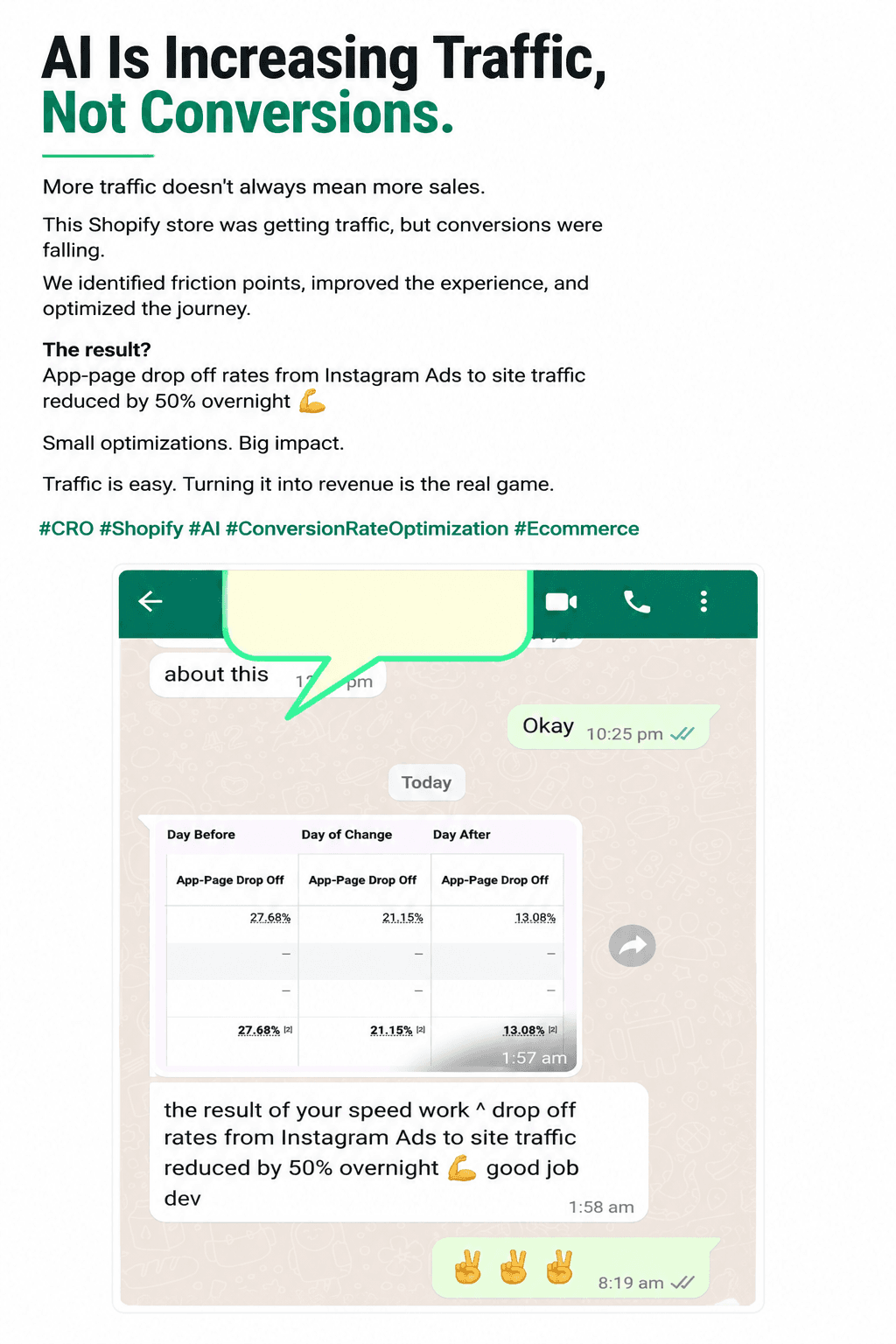
## Proof: Speed Alone Cut Drop-Offs by 50%
In one recent project, we focused on page speed and performance — no new creatives, no bigger ad spend.
App-Page drop-off from Instagram Ads:
- Day before: 27.68%
- Day of change: 21.15%
- Day after: 13.08%
That’s more than a 50% reduction in drop-offs overnight. Same traffic source. Same offer. Better technical performance.
Speed wasn’t a “tech task.” It was a conversion lever.
## What Every Business Should Rethink Now
If AI is becoming part of your acquisition mix, your site has to convert informed, impatient visitors. Start here:
1. Make your value proposition obvious within seconds. Visitors should know what you sell, who it’s for, and why it matters before they scroll.
2. Treat page speed as revenue infrastructure. Every extra second of load time taxes trust and kills momentum.
3. Remove friction from the buying journey. Fewer steps. Clearer CTAs. Less form fatigue.
4. Answer objections before users have to ask. Shipping, returns, guarantees, pricing clarity — put them where decisions happen.
5. Build trust near the CTA. Reviews, policies, and social proof belong next to action — not buried in a footer.
6. Choose clarity over clever design. Beautiful pages that confuse don’t convert.
## The Next Advantage Is Not More AI Traffic
AI is becoming a powerful acquisition channel. That part is real.
But the next competitive advantage won’t be getting more AI mentions or more referral sessions.
It will be converting the traffic you already have.
AI brings visitors. CRO turns them into customers.
At Techlyser, we build and optimize fullstack websites around that principle — performance, UX, and conversion systems that turn attention into revenue.
If your traffic is rising and sales are flat, the problem isn’t discovery. It’s the page.
Comments & Queries
Ask a question or share feedback. Comments are moderated before publishing.
No approved comments yet.
Previous
How Shopify Agentic Storefronts Could Transform AI-Powered Shopping
Next
Shopify Collections Update 2026: Source-Based Logic, Subcollections, and Variant Merchandising
Related Posts
Shopify Developer for Ongoing Store Setup and Support | Techlyser
Scaling an online store requires continuous technical refinement. Learn how dedicated ongoing Shopify development optimizes site performance, eliminates technical debt, and drives higher conversions.
How to Turn a Basic Online Store Into a Premium Brand
Discover how to transition your ecommerce store from a generic commodity catalog into a high-margin, premium brand experience through custom design and performance.
How to Get Your Shopify Store Discovered by ChatGPT and AI Search
Learn how to optimize your Shopify store for Generative Engine Optimization (GEO) to ensure ChatGPT, Perplexity, and Gemini recommend your products.