
Shopify Developer for Ongoing Store Setup and Support | Techlyser
The Strategic Value of Ongoing Shopify Development
Launching a Shopify store is only the first step in building a sustainable online retail business. As order volumes increase and catalog complexity grows, standard out-of-the-box templates and off-the-shelf applications quickly reach their functional limits. Growing brands require structural agility—the ability to deploy custom promotions, integrate third-party logistics systems, and maintain strict site performance standards without disrupting live operations.
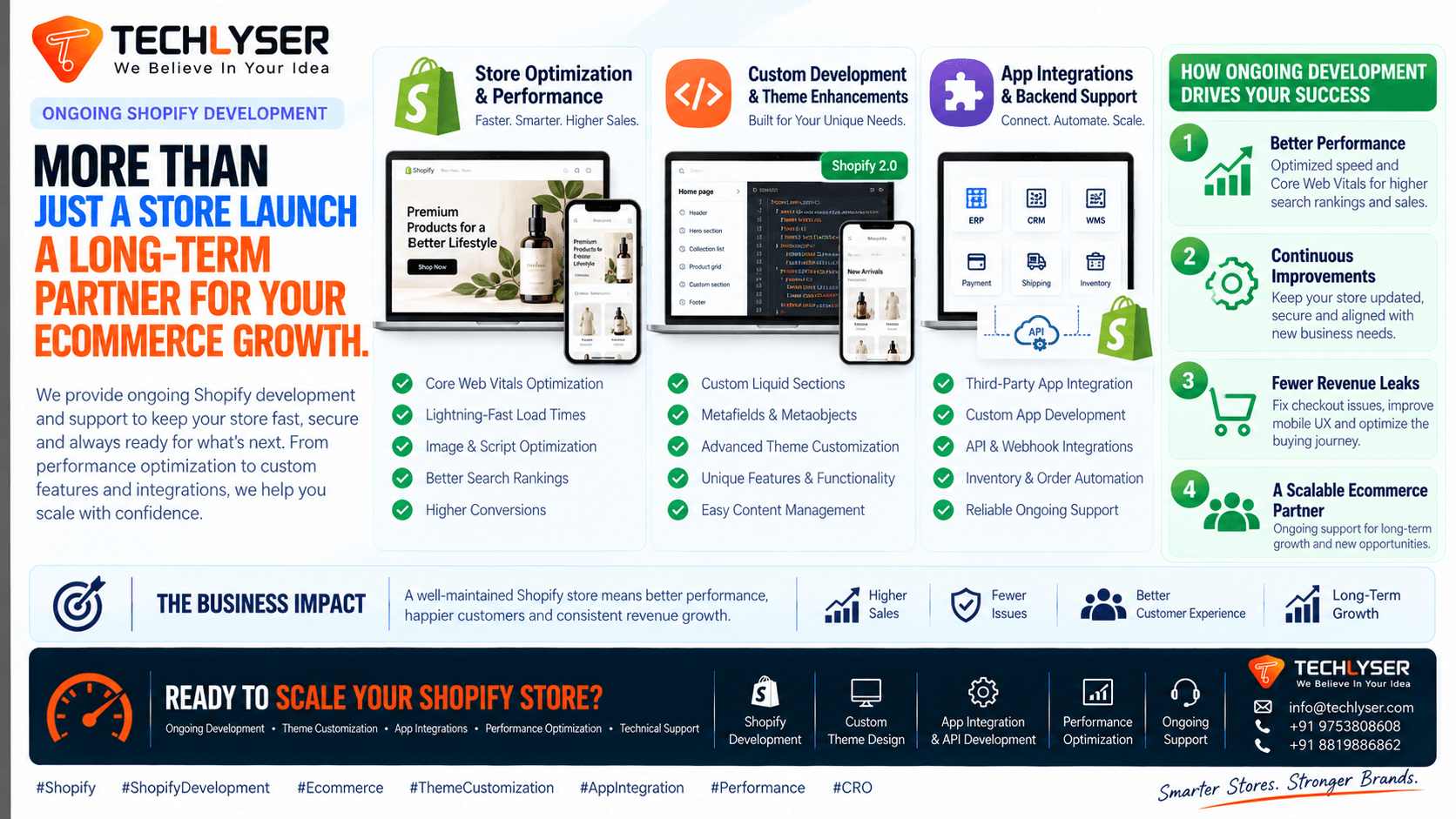
Working with a specialized Shopify developer for ongoing store setup and support transforms a static storefront into an evolving ecommerce asset. Instead of relying on reactive fixes when bugs arise, ongoing technical support ensures continuous performance tuning, custom feature engineering, and robust infrastructure monitoring.
Moving Beyond One-Off Store Launches
Many ecommerce leaders treat web development as a single project with a fixed end date. However, an active Shopify store is a dynamic application requiring constant refinement. Customer expectations shift, marketing channels evolve, and quarterly campaigns demand bespoke landing pages and promotional mechanics.
When store management relies entirely on non-technical team members or temporary freelancers, codebases quickly become cluttered. Unused app scripts accumulate, inline styling breaks layout consistency, and custom liquid templates become unmaintainable. Partnering with a dedicated team for ongoing store management ensures every platform change is executed against clean development standards.
Technical Debt in Scaling Ecommerce Architecture
Technical debt accumulates silently within Shopify stores through short-term modifications. Installing multiple single-purpose apps to handle simple functions—such as popups, badge displays, or basic custom fields—adds excessive JavaScript files and render-blocking resources to your theme.
Standard App Stack (Heavy)      -> Render-Blocking Scripts -> Slow Page Speeds -> Drop in Conversions
Custom Liquid / Native Setup    -> Optimized Asset Bundles -> Lightning Speeds -> High Conversions
Over time, this technical debt manifests as slow loading speeds, broken checkout flows on specific mobile devices, and layout shifts during high-traffic sales events. Proactive technical support audits and refactors existing code, replacing heavy third-party plugins with clean, native Shopify code or custom private apps.
Essential Ongoing Support Services for Growing Brands
Ongoing technical partnerships encompass far more than basic theme tweaks. They provide a structural roadmap for operational security, performance, and strategic customization.
Performance Optimization and Core Web Vitals
Site performance directly impacts organic search rankings and conversion rates. Every additional second of page load time systematically degrades conversion rates across both mobile and desktop channels. Dedicated developers continually review platform performance, focusing on key parameters:
- Largest Contentful Paint (LCP): Optimizing hero image delivery, liquid asset tags, and responsive image configurations.
- Interaction to Next Paint (INP): Minimizing main-thread JavaScript execution caused by third-party tracking pixels and chat widgets.
- Cumulative Layout Shift (CLS): Ensuring dynamic elements like dynamic checkout buttons and inventory badges preserve explicit dimensions.
Through continuous asset optimization, media compression strategies, and script prioritization, ongoing support retains top-tier performance benchmarks as catalogue inventory scales.
Custom Theme Enhancements and Liquid Customization
While Shopify's Online Store 2.0 architecture provides flexible section-based editing, custom brand visions frequently require custom Liquid sections, custom metafields, and bespoke frontend logic. Whether configuring complex bundle logic, multi-currency display rules, or custom subscription interfaces, bespoke code development prevents design compromises.
Professional developers construct custom sections that integrate natively with the Shopify Theme Editor, empowering internal marketing teams to launch tailored landing pages independently without compromising structural site integrity.
App Architecture Rationalization and API Integrations
As merchants expand operations, they inevitably connect specialized external systems—including Enterprise Resource Planning (ERP), Customer Relationship Management (CRM), Warehouse Management Systems (WMS), and bespoke inventory feeds. Maintaining reliable communication between these external applications and Shopify's Storefront or Admin APIs requires continuous supervision.
| Operational Need | Typical Low-Code Approach | Dedicated Developer Solution |
|---|---|---|
| Custom Product Bundling | 2–3 Third-Party Apps with Monthly Fees | Custom Native Liquid Logic & Storefront API |
| ERP Inventory Sync | Generic Connector App (Delayed Sync) | Custom Private App with Real-Time Webhooks |
| Landing Page Layouts | Drag-and-Drop Page Builder Plugins | Modular Native Online Store 2.0 Sections |
| Checkout Customization | Multi-app Workarounds | Native Shopify Functions & Checkout UI Extensions |
Ongoing technical assistance ensures webhooks, background sync tasks, and API connections run reliably without data corruption or sync latency.
How Dedicated Shopify Developers Prevent Revenue Leakage
Ecommerce revenue is lost through small, overlooked technical breakdowns. A broken discount code input during a major ad campaign or a slow slide-cart render on iOS devices directly leads to abandoned carts.
Eliminating Checkout Bottlenecks
For merchants eligible for checkout customization through Shopify Functions or Checkout UI Extensions, technical support allows custom business logic to run securely directly within the checkout flow. From dynamic shipping rules based on customer tags to customized address validation, optimizing checkout friction directly secures top-line revenue.
Mobile Usability Improvements
Over 70% of ecommerce traffic originates on mobile devices, yet mobile conversion rates consistently lag behind desktop. Dedicated developers perform continuous device testing, diagnosing touch-target issues, viewport bugs, and navigation friction points that standard testing tools miss.
Proactive Conversion Rate Optimization (CRO)
Conversion optimization is an ongoing discipline of testing and refinement. Having dedicated development support allows ecommerce brands to quickly execute A/B test variants, implement sticky add-to-cart components, and test streamlined navigation patterns based on real user behavior metrics.
At Techlyser, our development teams help merchants implement precise frontend custom code that directly accelerates store conversion speeds and resolves architectural bottlenecks.
Selecting the Right Partner for Long-Term Ecommerce Growth
Choosing between ad-hoc freelancing marketplaces, internal hiring, and specialized agency retainers impacts operational stability and cost efficiency.
In-House vs. Agency Retainer Models
Building an in-house engineering team requires significant overhead and recruitment timelines. Conversely, hiring ad-hoc freelancers often leads to fragmented code quality and unpredictable availability during critical site outages.
A dedicated retainer with a specialized web development agency offers balance: immediate access to full-stack engineering expertise, rigorous quality assurance, and predictable monthly expenditure.
What to Expect from Techlyser Shopify Development Services
When partnering with experienced specialists, ongoing platform management includes:
- Comprehensive Technical Audits: Initial review of liquid code, installed applications, site architecture, and Core Web Vitals.
- Structured Sprint Planning: Prioritized backlogs matching technical updates to key commercial promotional calendars.
- Staging and Version Control: All work developed within isolated preview environments using Git-based version control before deployment.
- Dedicated SLA and Emergency Support: Immediate mitigation procedures for critical operational interruptions.
Investing in a professional Shopify developer for ongoing store setup and support provides the structural foundation required to scale your ecommerce business predictably.
Comparison
| Factor | Ad-Hoc / Freelance Fixes | Ongoing Dedicated Tech Partner |
|---|---|---|
| Response Time | Reactive (hours or days) | Proactive (planned sprints & rapid SLA) |
| Code Quality | Patchwork & app bloat | Clean, maintainable theme code |
| Performance Focus | Rarely considered during quick fixes | Continuous Core Web Vitals optimization |
| Business Alignment | Task-focused execution | Growth & conversion-oriented strategy |
Frequently asked questions
Why do I need a Shopify developer for ongoing store setup and support instead of one-off hires?
Ongoing development support ensures continuous site performance optimization, regular security and app audits, fast resolution of technical bugs, and seamless implementation of custom features as your ecommerce business scales.
How does technical support help improve my store's Core Web Vitals?
Dedicated Shopify developers audit render-blocking scripts, refactor custom Liquid code, optimize media assets, and reduce third-party app dependency to achieve optimal LCP, INP, and CLS scores.
Can an ongoing support partner replace third-party Shopify apps with custom code?
Yes. Experienced developers can replace heavy, fee-based third-party apps with clean native Liquid sections, metafields, or private API integrations, significantly improving loading speeds and reducing monthly app costs.
What is the difference between an agency retainer and hiring an in-house developer?
An agency retainer provides instant access to a full team of full-stack engineers, UI/UX designers, and platform specialists for a predictable monthly cost without the overhead and hiring delays of in-house personnel.
Scale Your Shopify Store Without Technical Limits
Partner with Techlyser for proactive, ongoing Shopify development, speed optimization, and custom feature engineering tailored to your revenue goals.
Previous
Custom Shopify UX Strategy: Scaling Beyond Templates
Next
Optimizing Liquid for Shopify: Architecture & Speed
Related Posts
How to Turn a Basic Online Store Into a Premium Brand
Discover how to transition your ecommerce store from a generic commodity catalog into a high-margin, premium brand experience through custom design and performance.
How to Get Your Shopify Store Discovered by ChatGPT and AI Search
Learn how to optimize your Shopify store for Generative Engine Optimization (GEO) to ensure ChatGPT, Perplexity, and Gemini recommend your products.
How Much Does It Cost to Build a Shopify Store in 2026?
Planning your ecommerce budget for the year ahead? Here is a realistic, expert breakdown of the actual development costs, hidden fees, and optimization strategies for building a Shopify store in 2026.